

My buddy Rich has a spreadsheet for everything. Fantasy football projections. His kids’ college funds. The exact cost-per-mile of his Camry versus his wife’s SUV. Last summer he spent an entire round on the back nine of our local golf course calculating whether his golf pass was “worth it” instead of just enjoying the round.
“I think I’m up about $180,” he announced on the 16th tee, squinting at his phone. “Maybe $220 if you count that twilight round at Fowler’s Mill.”
I shanked my drive into the trees. Partly because of the wind. Mostly because I was laughing.
Here’s the thing-Rich wasn’t wrong to wonder. “Save up to 50% on green fees” sounds great in an ad, but it doesn’t answer the question you’re actually asking: Will this thing pay for itself for me?
We’ve heard that question for 33 years. So we finally built something to answer it: a golf savings calculator that does the math for you.
Introducing the Golf Savings Calculator
We just launched a new tool that does what Rich’s spreadsheet couldn’t: gives you a personalized, realistic estimate of what you’ll actually save this season.
Try the Golf Savings Calculator →
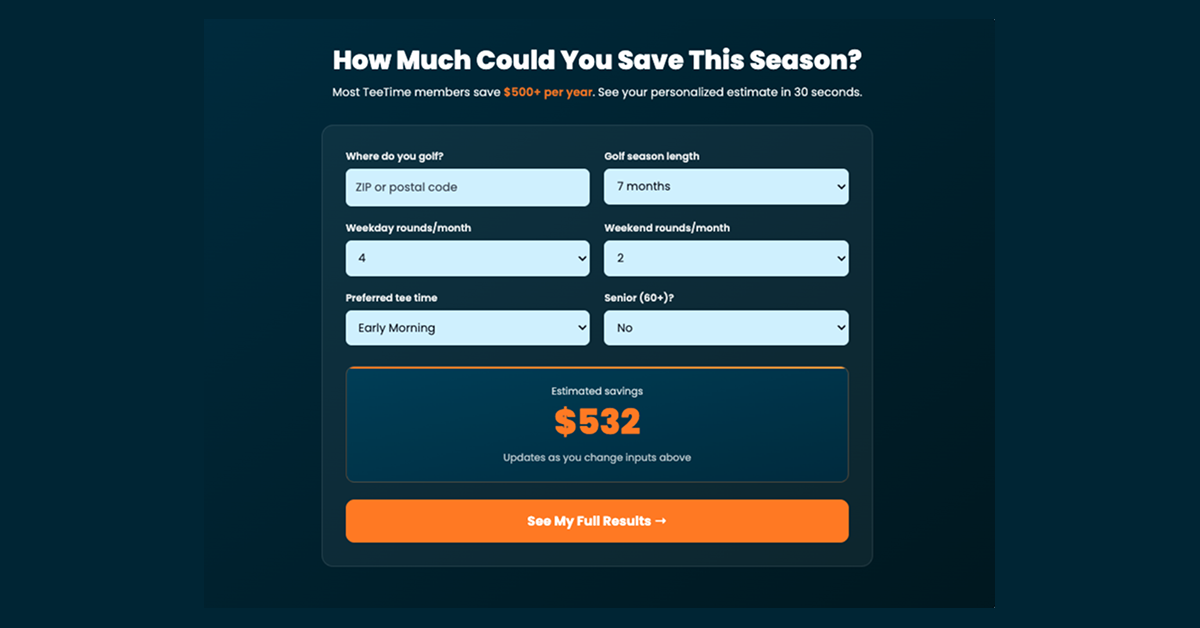
It takes about 30 seconds. You plug in how you actually play-where, how often, what time of day, whether you’re a senior-and it shows you the math. Your estimated annual savings. How many rounds to break even. How many courses are near you.
No guesswork. No spreadsheets on the 16th tee. Just real numbers based on your game.
Why the Generic Claims Don’t Work
Let’s be honest-golf marketing can be vague. We’re guilty of it too. “Save up to 50%” doesn’t tell you much when you’re trying to figure out if a $65 membership makes sense for your game.
The math looks completely different depending on how you play. Rich plays four rounds a week from April through October. His neighbor plays twice a month, weekends only. Both might benefit from a golf pass-but the numbers aren’t even close to the same.
Green fees vary wildly by region, time of day, and day of week. A Saturday morning tee time costs more than a Tuesday twilight. Senior discounts change the equation entirely. And that “up to 50%” claim? Technically true. But not particularly useful if you can’t figure out what you’ll actually save.
Generic claims can’t capture any of that. A calculator can.
작동 방식
You plug in a few details about how you actually play:
Where you golf – Your ZIP code helps us pull in courses and pricing data from your area.
Your golf season length – Playing year-round in the Carolinas? Or a 5-month season in the Upper Midwest?
Weekday rounds per month – Those Tuesday and Wednesday rounds add up.
Weekend rounds per month – Prime time pricing, but still discounted with the pass.
Preferred tee time – Early morning, late morning, afternoon, or twilight.
Senior status – If you’re 60+, you often qualify for even deeper discounts. (More on that in our senior golf discounts guide.)
The calculator weighs all of these factors against average green fee data in your area and spits out a number. Your mileage will vary based on which specific courses you play, but it gives you a realistic ballpark-not a marketing claim.
The Real Math Behind the Estimates
We built this calculator based on real data from our 1,100+ partner courses across 20+ states and Ontario. The savings estimates reflect actual discounts our members see – typically 25% to 50% off standard green fees, depending on the course and time slot.
Season length is probably the biggest factor. Twelve months in Florida means twice as many opportunities to use the pass as a six-month season in Michigan. More rounds, more savings.
Weekday vs. weekend pricing affects your per-round savings. Weekend rates are higher at most courses, so your discount in dollar terms is often bigger on Saturday morning than Tuesday afternoon. But weekday golfers tend to play more frequently, so total savings can actually be higher.
Tee time preference matters because twilight rounds are already discounted at most courses. Early morning and prime time slots have the highest rack rates-which means bigger discounts when you use the pass.
Senior status is a bonus multiplier. Many of our partner courses offer additional senior-specific deals through TeeTime Golf Pass that stack on top of standard discounts.
Four Golfers, Four Different Numbers
Let me run through some real scenarios.
The Weekend Warrior in Ohio
Plays about twice a month, almost always on weekends, usually early morning tee times. Not a senior. Season runs April through October.
Estimated savings: $180-$220 per year after the cost of the pass. That’s basically 3-4 free rounds. Break-even happens around round three.
The Retired Regular in Pennsylvania
Plays 4 times a week during a 6-month season. Weekday mornings. Senior rates.
This is where the pass really shines. We’re talking potential savings of $800-$1,000+ per year. At that volume, the pass pays for itself in the first week or two of the season. Everything after that is gravy.
The Twilight Player
Busy professional squeezing in 2-3 rounds a week after work. Twilight rates, weekdays only, 7-month season.
Per-round savings are smaller since twilight rates are already discounted, but frequency makes up for it. Estimated savings: $400-$500 annually. Still a solid return on a $65 investment.
The Florida Snowbird
Playing year-round with a mix of weekday and weekend rounds, 3-4 times a month.
That 12-month season adds up fast. Estimated savings of $350-$450 isn’t uncommon.
These are ballpark numbers. Your results depend on which courses you play and how often. But the calculator gives you a personalized estimate based on your specific inputs.
Why We Built This (After 33 Years)
We’ve been in the golf deals business since 1992. More than a million golfers have used TeeTime Golf Pass. We know the savings are real because members tell us constantly – “$600 last season,” “paid for itself in three rounds,” that kind of thing.
But here’s what we also know: skepticism is reasonable. There are plenty of “discount” programs out there that don’t deliver. And every golfer’s situation is different. A retired guy in Pennsylvania playing four rounds a week is going to save a lot more than a weekend warrior in Michigan who gets out twice a month.
For years, we told people “you’ll save money” and expected them to trust us. That’s not good enough anymore. So we built the calculator to put the actual numbers out there-personalized to how you play, not based on some hypothetical golfer who doesn’t exist.
If the math doesn’t work for your game, we’d rather you know that upfront than find out later. And if it does? Stop wondering and start saving.
The estimates are conservative, by the way. Most members who use their pass regularly tell us they save more than the calculator predicted, not less. We’d rather under-promise.
The Fine Print (It’s Short)
The estimates are based on averages. Your actual savings depend on which specific courses you play. Some offer deeper discounts than others.
You have to actually use the pass. This probably goes without saying. The savings only happen if you tee it up.
We have a 30-day money-back guarantee. If you get the pass and it’s not working out-maybe you moved, got injured, whatever-you can return your unused pass within 30 days for a full refund. Details on our money-back guarantee page.
There are no hidden fees. You pay for the membership, then pay the course’s discounted rate when you play. No booking fees, no convenience charges.
Try It Yourself
The calculator takes about 30 seconds. Plug in your ZIP code, adjust the sliders to match how you actually play, and see what the numbers say.
Try the Golf Savings Calculator →
We’ve got regional passes covering the Midwest, Mid-Atlantic, Northeast, and more-or the Super Pass if you want access to all 1,100+ courses. You can also search courses by location or download the Golf Deals App to browse deals on your phone.
And if the numbers don’t work for you? At least you’ll know.
자주 묻는 질문
How accurate is the golf savings calculator?
It’s based on average savings our members see at courses in your area-typically 25-50% off green fees depending on the course and time slot. Your actual results vary based on which specific courses you play, but the calculator gives you a realistic ballpark.
How quickly can the TeeTime Golf Pass pay for itself?
Most members break even in 2-3 rounds. After that, every discount is pure savings. The calculator shows you exactly how many rounds you’ll need based on your playing habits.
Are there any hidden fees?
Nope. You pay for your membership, then pay the course’s discounted rate when you play. No booking fees, no service charges.
What if it doesn’t work for me?
We offer a 30-day money-back guarantee. If you’re not seeing the savings, return your unused pass for a full refund.
How do I find courses near me?
Search courses by location on our website, or download the Golf Deals App to browse deals on your phone.
Rich texted me last week. He ran his numbers through the calculator.
“$847,” he wrote. “I was off by $627.”
I told him next time he could skip the spreadsheet and just enjoy the round. He said he’d think about it.
He won’t. But at least now he’s got a better number to obsess over.
Data sources: Green fee statistics referenced from the National Golf Foundation, which reported 545 million rounds played in 2024. Average public course green fees have risen to approximately $49 nationally according to Today’s Golfer, though GOLF.com notes significant regional variation.